The Input Problem: Why Audio Is the AI Attack Surface Nobody Is Governing
Blog post description.
5/29/20262 min read
My post contentMost organizations governing AI are focused on outputs. Bias in decisions. Hallucinated content. Data privacy.
Here's what's getting less attention: the inputs.
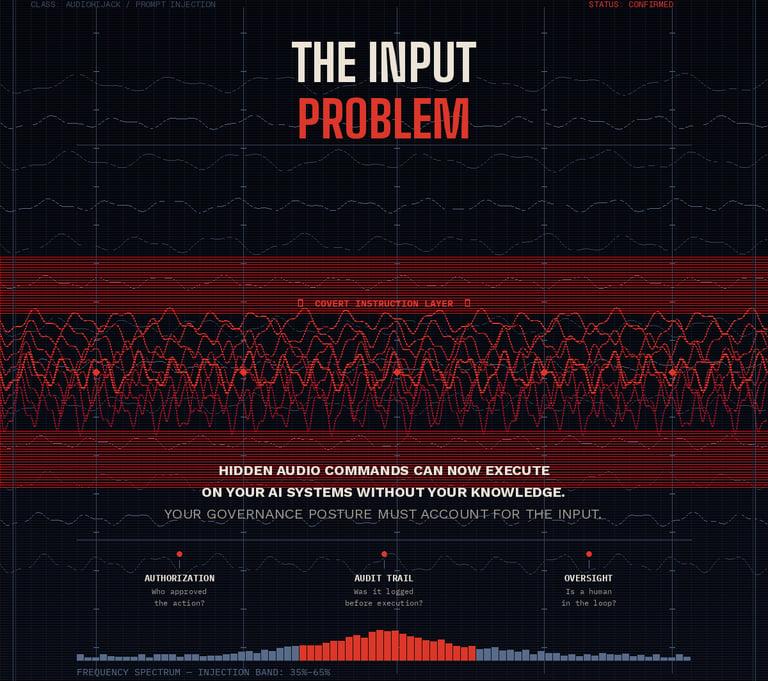
Researchers from Zhejiang University, the National University of Singapore, and Nanyang Technological University just demonstrated something that should be on every AI governance leader's radar. Hidden audio signals embedded in music, videos, and voice calls can hijack AI voice assistants into performing unauthorized actions, including web searches, file downloads, and sending emails, without users hearing anything unusual.
They call it AudioHijack. The attack doesn't require malware or device access. It hijacks the AI model itself through sound by subtly altering audio waveforms so humans hear normal audio while the AI interprets hidden patterns as commands.
Think about what that means in practice.
Your meeting transcription tool is running during a sensitive leadership call. A podcast plays in the background. A video gets shared in the room. Attackers could hide malicious prompts inside that music, video, or voice content, and if your AI assistant has access to email, calendars, or file systems, those hidden commands can execute on your behalf without you ever knowing.
This is not a theoretical edge case. The deeper problem is architectural. Large language models consume streams of tokens and infer intent from context. If an application flattens user commands, documents, emails, transcripts, and tool results into one conversational stream, the model is left to decide which words are instructions and which words are data. That boundary is already fragile with text. Audio makes it harder because the hostile instruction may never appear in a way a human reviewer would notice.
And if the agent acts before anyone reviews the transcript, your audit trail is already broken.
This is exactly why human oversight isn't just an ethical principle. It's a control requirement. AI systems with agentic capabilities, the ones that can act and not just respond, need defined authorization limits, action logging, and human checkpoints before consequential steps are taken.
Three governance questions worth asking right now:
Which AI systems in your environment have agentic capabilities? If they can send emails, search files, or execute commands, they are in scope for this threat.
What is the authorization model? Can the system act autonomously, or does a human approve before action is taken?
What does your audit trail actually capture? If a system acts on a hidden instruction, would you know? How quickly?
The attack surface for enterprise AI is expanding faster than most governance programs are moving. Audio input just joined the list.
This is the work.
Let's Build the Right AI Strategy for You
Every engagement starts with understanding your specific context, constraints, and goals rather than a templated pitch. Complete the form below to start a conversation, or reach out directly. For government clients, we can provide capability statements, CAGE codes, and NAICS information to support your procurement process.
Alternative Contact Methods
GOvernment clIeNts:
gov@arcpointconsulting.com
PHONE: (240) 244-9850
BUSINESS HOURS: Mon–Fri, 9am–6pm
© 2026. All rights reserved.
commercial clients:
info@arcpointconsulting.com